A personalised gift works when it is something the person already uses, with a detail only you would know. Here is how to pick the piece, the words and the timing.
Part of our guide: The Complete Guide to Personalised Gifts in India
The short answer
- Choose something the person already uses every day (keys, a cap, a desk, a wall) and add one detail that belongs only to them.
- A name, a pair of initials or a date nearly always ages better than a long message.
- Made-to-order gifts need time. Order at least 10 to 12 days before the day you need it; three weeks before a festival.
- Check the spelling twice, and ask for a photo proof before the piece is made.
Most gifts are used for a week and then put in a drawer. The ones that stay out, on a key ring, a wall or a desk, usually have two things in common: they do a job the person already needed doing, and they carry a detail that could not belong to anyone else. That second part is what a personalised handmade gift is for.
This guide is for anyone choosing a gift for a birthday, an anniversary, a wedding, a new baby or a thank-you, and wondering whether to personalise it, what to put on it and how early to order. It is written from the maker's side of the table: the questions below are the ones we wish every customer asked before ordering.
What is a personalised handmade gift?
A personalised handmade gift is an object made by a person, not a production line, and finished with something specific to the recipient: a name, initials, a date, a short line or a photograph. Two things set it apart from a printed mug bought off a shelf.
- It is made to order. Nothing exists until you ask for it, so it cannot be dispatched the same afternoon.
- No two are identical. Pressed flowers sit differently in every resin keychain, and hand embroidery never repeats exactly. That variation is the point, not a defect.
"Personalised" and "customised" are often used to mean the same thing. If there is a difference, it is this: customised means you chose from options (a colour, a size); personalised means the piece carries something that identifies one person. The best gifts usually do both.
Start with the person, not the product
It is tempting to scroll through products until something looks nice. A quicker route is to answer three questions about the person first, and let the answers narrow the choice.
- What do they carry or wear every day? Keys, a bag, a cap, a handkerchief. A gift that joins a daily habit gets used without any effort from them.
- What do they keep on display? Some people fill their walls and shelves; others keep every surface clear. A frame or a wall clock suits the first kind and annoys the second.
- What is the story between you? A date, a nickname, a place, a phrase only the two of you use. This is the detail that makes it theirs.
Gift ideas by occasion
Different occasions call for different kinds of object. The table below pairs each occasion with what tends to work and what to put on it. Use it as a starting point, not a rulebook.
| Occasion | What works | What to put on it |
|---|---|---|
| Birthday | Name keychain, embroidered cap, printed T-shirt | Their name or nickname |
| Anniversary | Couple keychain set, framed print, ribbon rose bouquet | Both initials and the wedding date |
| Wedding | Family name frame, monogrammed handkerchiefs | The couple's names and the date |
| New baby or naming ceremony | Name frame for the nursery, keepsake keychain for the parents | The baby's name and date of birth |
| Raksha Bandhan or Bhai Dooj | Name keychain, cap, handkerchief set | A childhood nickname |
| Housewarming | Hand-painted wall clock, family name frame, bud vase | The family name, or nothing at all |
| Farewell or Teachers' Day | Keychain, framed print with a short line | Their name and the year |
Notice that the housewarming row says "or nothing at all". Not every handmade gift needs a name on it. A hand-painted clock or a bouquet of ribbon roses is already one of a kind. Personalise when the name adds meaning, not out of habit.
Gift ideas by budget
A larger budget buys a larger or more time-consuming piece, not a more thoughtful one. Here is what each range typically covers for handmade work in India. Prices vary between studios, so treat the ranges as a guide.
Under ₹500
Small pieces that are carried: a resin name keychain, a single embroidered handkerchief, a small ribbon-flower posy. This is the best range for classmates, colleagues and "just because" gifts, and for adding a personal touch to a bigger present. You can browse gifts under ₹500 to see what is available now.
₹500 to ₹1,000
Wearables and sets: an embroidered name cap, a printed T-shirt, a set of monogrammed handkerchiefs, a pair of couple keychains. Most birthday gifts for friends and siblings sit here. See gifts under ₹1,000.
₹1,000 to ₹2,000
Display pieces: a pressed-flower photo frame, a family name frame, a hand-painted wall clock, a full ribbon rose bouquet. These suit anniversaries, weddings and housewarmings, where the gift is for a home as much as a person.
Above ₹2,000
Combinations: a frame with a bouquet, or a small hamper of matching pieces, gift-wrapped together. If you are spending this much, two modest pieces that relate to each other usually land better than one large one.
What to write on it
This is where most people hesitate, and where most regret comes from. A few rules make it simple.
Shorter is better
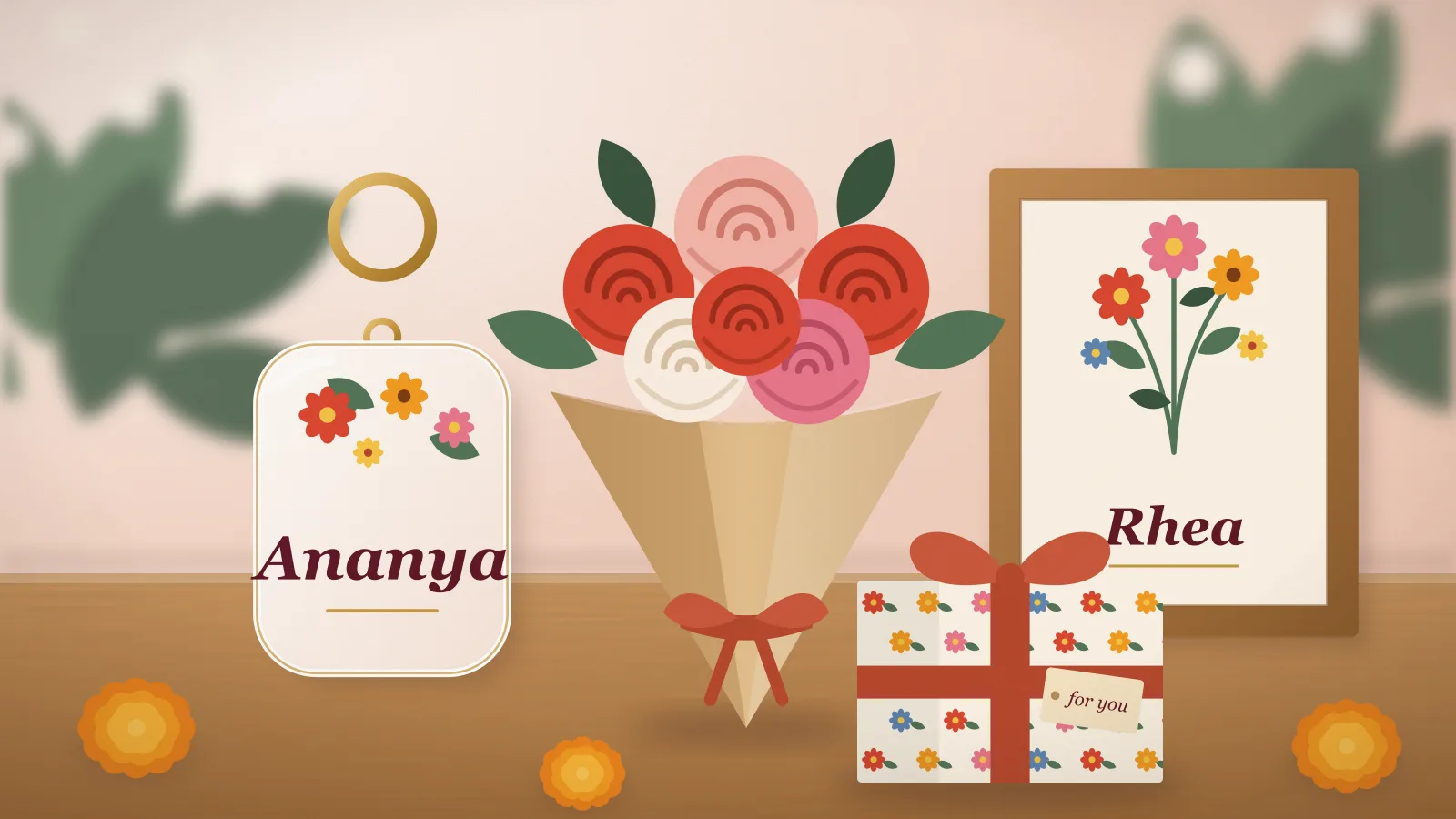
Small pieces have small spaces. A keychain typically takes about 12 characters, which is one name: "Ananya" fits comfortably, "Ananya & Karthik" does not. If the words do not fit, the lettering has to shrink until it is hard to read. When in doubt, choose the shorter version: a first name instead of a full name, initials instead of two names.
Choose one of four things
- A name or nickname. The safest and most used. Nicknames are warmer than formal names.
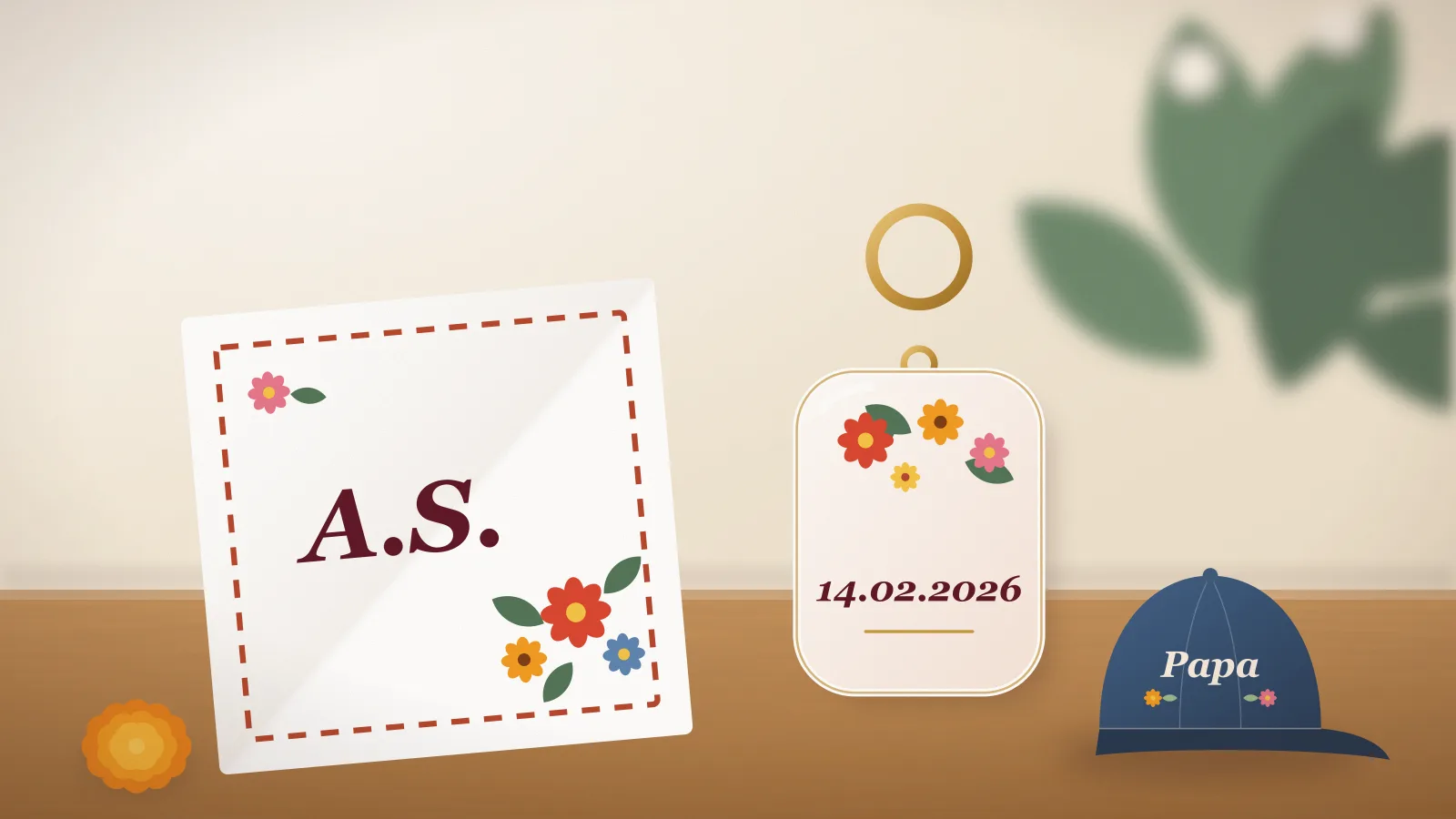
- Initials. "A & K" or "A.S." suits couples, handkerchiefs and anything worn at work.
- A date. A wedding date or a date of birth, written as 14.02.2026 or 14 Feb 2026.
- A short line. Three or four words at most: "Est. 2019", "Home is here", "Best Papa".
Avoid what will date badly
Inside jokes from this month, a job title, a slogan from a film that released last week. A gift meant to last years should carry words that will still be true in years. If you would be slightly embarrassed to see it in 2031, leave it off.
Check the spelling, then check it again
A handmade piece is made exactly as written. Type the name, read it aloud letter by letter, and if it is a name you do not write often (a colleague, an in-law), confirm it with someone. Indian names have many accepted spellings: Shruti and Shruthi, Aarav and Arav, Sneha and Snehaa are all correct for somebody. The only right spelling is the one the person uses.
Handmade or mass-produced: what are you paying for?
A printed keychain from a marketplace can cost under ₹100. A handmade resin one costs three or four times that. It is fair to ask why.
- Time. A resin piece is poured in layers and left to cure between each. Embroidery is stitched letter by letter. That is hours of a person's attention, not seconds of a machine's.
- Materials. Real pressed flowers, cotton fabric and wooden frames cost more than plastic and stickers, and they age differently: they soften and settle instead of peeling.
- A person to talk to. If you want the name a little larger or the flowers in yellow, you can ask. A factory cannot hear you.
Handmade is not automatically better. For fifty identical giveaways at an event, mass-produced may be the sensible choice. For one person you know well, the difference is visible the moment they open it.
How a made-to-order gift is made, and how long it takes
Knowing the steps helps you plan. Most made-to-order studios, ours included, follow the same order.
- You order and give the details: the name, the option (colour or size) and any note.
- The studio prepares a design proof: a photo or mock-up showing the wording and layout.
- You approve it, or ask for a change. Nothing is made until you say yes. This is your chance to catch a spelling slip.
- The piece is made. Depending on the piece this takes a few working days: resin needs curing time, and embroidery and painting cannot be rushed.
- It is packed and shipped. Add the courier's time for your city.
Each product page shows its own making time. You can read the whole process on our how personalisation works section.
Five mistakes to avoid
- Ordering too late. The most common one. A made-to-order gift ordered three days before the occasion will arrive after it.
- Writing too much. A paragraph on a keychain becomes unreadable. Put the long message in the handwritten note instead.
- Guessing the spelling. Ask. Nobody minds being asked how their name is spelt; everybody notices when it is wrong.
- Skipping the proof. Approving without looking defeats its purpose. Read every letter.
- Personalising for yourself. The colour you love may not be theirs. Choose what they would pick.
Looking after a handmade gift
A line of care advice in the card is a kindness. These basics hold for most handmade pieces.
- Resin pieces: keep them out of long hours of direct sunlight and away from heat, which can yellow clear resin and fade pressed flowers over time. Wipe with a soft dry cloth.
- Embroidered caps and handkerchiefs: wash in cold water by hand or on a gentle cycle, and iron on the reverse side so the thread keeps its sheen.
- Printed T-shirts: wash inside out and do not iron directly over the print.
- Wooden frames and clocks: dust with a dry cloth, and hang away from damp walls and kitchens.
- Ribbon and paper flowers: keep dry and out of direct sun; they need no water and will not wilt.
A checklist before you order
- Do I know one thing this person uses or displays every day?
- Have I chosen a name, initials, a date or a short line, and is it within the character limit?
- Have I confirmed the spelling with someone who would know?
- Is there enough time: at least 10 to 12 days, or three weeks before a festival?
- Is it going straight to them? If so, have I added gift wrap and a note, and their address and phone number?
If you can tick all five, you are ready. The gift does not need to be large or expensive. It needs to be theirs.
Questions people ask
What is the best personalised gift for someone who has everything?
Choose something small that they use daily, such as a keychain or a handkerchief, and personalise it with a nickname or a date that matters to the two of you. People who have everything rarely have something made only for them.
How many days before the occasion should I order a personalised handmade gift?
Order at least 10 to 12 days ahead: a few working days for the design proof and making, and a few more for delivery. Before Diwali, Raksha Bandhan and Valentine's Day, order three weeks ahead, because studios and couriers are at their busiest.
What should I write on a personalised gift?
Keep it short: a name or nickname, initials, a date, or a line of three or four words. Small pieces such as keychains take about 12 characters. Save longer messages for the handwritten note that goes with the gift.
Can I see the design before it is made?
Yes. A good made-to-order studio sends a photo or mock-up of the design and makes the piece only after you approve it. Use the proof to check the spelling letter by letter.
Are handmade gifts worth the higher price?
For one person you know well, usually yes. You are paying for a maker's time, better materials and the option to ask for changes. For large numbers of identical giveaways, mass-produced items may be more practical.
Can a personalised gift be returned?
Because a personalised piece is made for one person, most studios cannot resell it and so do not accept returns for a change of mind. If it arrives damaged or the wording differs from what you approved, contact the studio straight away with photos. This is another reason to check the proof carefully.
Ready to choose?
Browse pieces that can carry a name, and see the design before we make it.
Written by Srushti Pawar
HeartCraftedStudio is a brand of Quavento Technologies. We make personalised gifts by hand, to order. These guides are written to help you choose, and we say when an idea comes from another maker. Published .