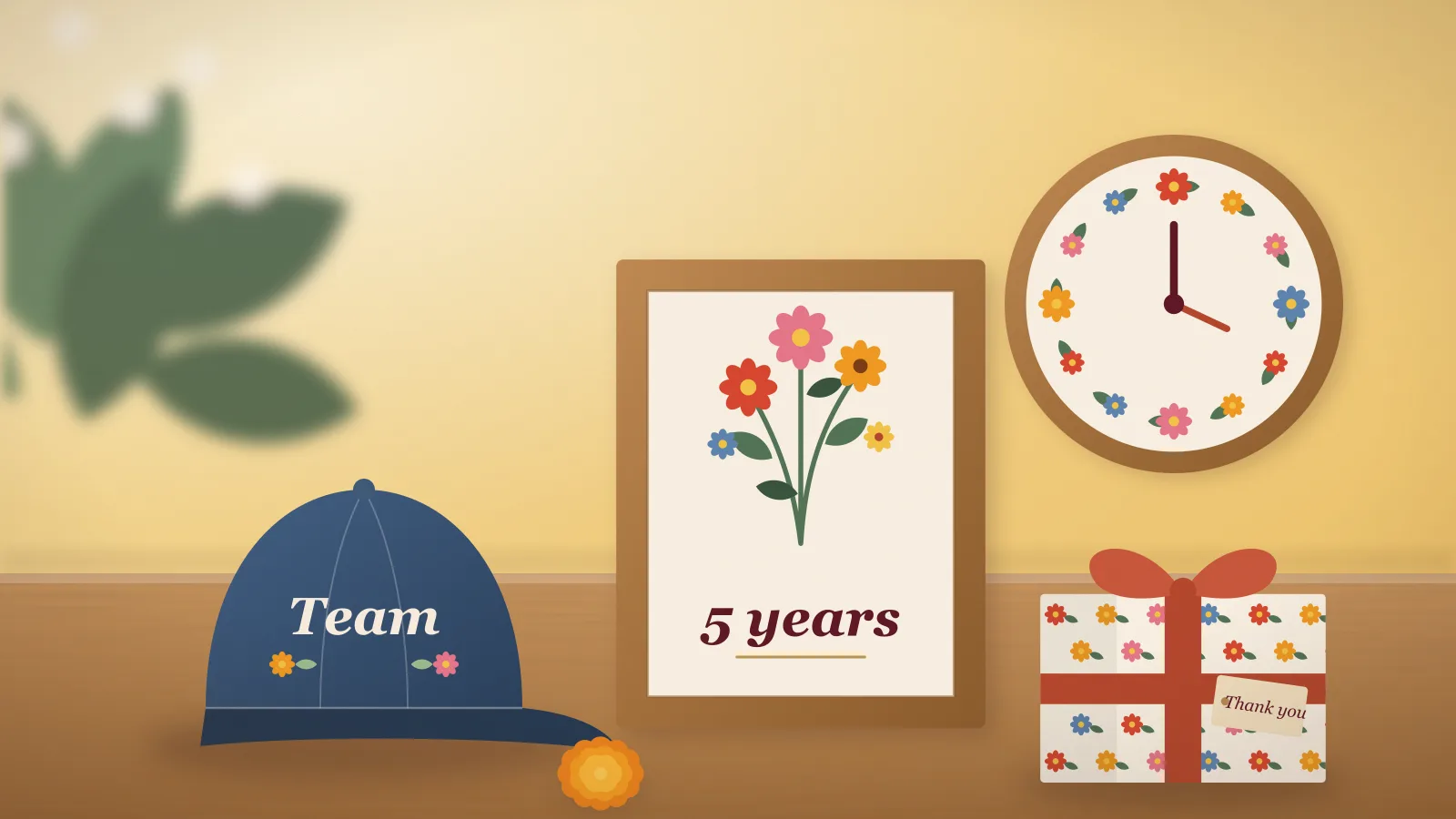
A practical guide to recognising employees with gifts that mean something: ideas by milestone, how to keep a programme fair, how to personalise and what to put in the note.
The short answer
- Appreciation works when it is specific, timely and personal. A gift that says what the person did, given soon after, is worth more than a larger one given late with a general thank-you.
- Run milestones on a simple, fair scheme: the same type of gift at the same years for everyone, with a higher tier for longer service. Fairness matters more than size.
- Personalise with a name and a handwritten note. The note is the part that is kept.
- Avoid gifts that look like pay in disguise, gifts that are for the company's benefit, and anything too personal.
- Plan ahead. A monthly list of upcoming anniversaries and a standing order for personalised pieces makes the programme calm.
People remember being thanked far longer than they remember what they were given. Employee appreciation gifts and work anniversary gifts are a way of making the thanks visible, and of marking the years that a person has chosen to give to a place. The best programmes are simple, fair and sincere. The worst are generic, late and quietly resented.
This guide helps HR teams, managers and founders design a programme, with ideas by milestone, a fair structure, advice on personalising and a few words on what to write. If you are choosing for a new joiner, the guide to a welcome kit for new employees comes first, and the corporate gifting page explains how to ask for a quote for numbers.
Four principles of good recognition
- Be specific. "Thank you for staying until the launch was safe" lands better than "thanks for your hard work". Say what the person did.
- Be timely. A thank-you given within days of the effort is felt. The same thing six months later is a ritual.
- Be fair. If one person is thanked with a gift and another who did equal work is not, the gift becomes a grievance. Use clear, public criteria for milestones.
- Be personal. A gift that could have been given to anybody says little. A name, a note and one detail that shows you know the person say a great deal.
Work anniversary gift ideas by milestone
A simple tiered scheme works for most workplaces: a small, warm gesture at the first year, something with a little more substance at three and five, and something lasting at ten. The table below is a starting point, not a rule. Adjust it to your budget and your culture.
| Milestone | What suits it | The note |
|---|---|---|
| One year | A personalised keychain or notebook, with a card from the manager | Thank them for the first year and say one thing they did well |
| Three years | A framed team photograph, a desk piece or a personalised wall clock | Mention a specific project or change they were part of |
| Five years | A lasting keepsake, such as a framed piece with their name and the years | A longer letter from the head of the team or the founder |
| Ten years | A considered keepsake, a bouquet that lasts and a gathering of the team | A letter that looks back over the decade, with notes from colleagues |
| Beyond ten years | Something chosen with the person in mind, after a conversation | A personal letter from the leadership |
At one year
The first anniversary is easy to overlook, and it is when many people decide whether to stay. A small personalised gift, such as a name keychain or a notebook, with a handwritten card from the manager, says "we noticed". Give it on the day, not the week after.
At three and five years
A framed photograph of the team, a personalised wall clock or a piece for the desk. At five years add a longer note, and if you can, a short gathering. The handcrafted corporate gifts guide has ideas that suit this level.
At ten years and beyond
A decade is a long time. A keepsake that carries the years, a bouquet that does not wilt for the home, and a letter that the person can keep. Ask colleagues for a line each and gather them in a folder. People often keep this for life.
Appreciation gifts for a job well done
Not every thank-you waits for an anniversary. A launch that went well, a difficult month, a colleague who covered for someone: these are moments for a quick, thoughtful gesture.
- A handwritten card from the manager, saying what the person did and what it made possible. It is free and it is often the best.
- A small personalised gift, such as a keychain or a handkerchief with their name, handed over in person.
- Flowers that do not wilt, for a desk or a home, after a hard stretch.
- A team lunch or a shared moment, with the person's contribution named out loud.
- A day to rest, where the culture allows it. Time is the gift most people want and fewest receive.
Keeping the programme fair
A recognition scheme can go wrong not because the gifts are poor but because the rules are unclear. People notice who is thanked and who is not, and they notice quickly.
- Write the scheme down, and share it. A tier at one, three, five and ten years, with the same type of gift at each, removes argument.
- Treat every department the same. A gift for the sales team and nothing for the accounts team creates quiet resentment.
- Include remote and part-time staff. Post a gift to them, and make the card as warm as for anyone on site.
- Keep gift values consistent, and avoid gifts that look like pay in disguise. A gift is a thank-you; a bonus is a bonus.
- Do not make recognition a competition. If a gift is for the best performer, people will begin to resent each other. A milestone gift for everyone who reaches it is kinder.
Personalising, and avoiding mistakes
A name on a gift is the cheapest way to make it personal, and the commonest way to make it embarrassing. Collect names in each person's own spelling, and write them in a single list that is kept and updated. Check the proof letter by letter. If the gift includes the number of years, be certain of the date, because a wrong number on an anniversary gift is a small, visible mistake.
- Keep a calendar of anniversaries and look at it monthly, so that gifts are ordered early.
- Check dates against HR records, not memory.
- Order personalised pieces about three weeks ahead. They are made to order and need about two weeks.
- Keep a few spare, unpersonalised gifts for last-minute thanks.
What to write in the note
- "Five years. Thank you for the way you handled [a specific thing], which made the whole team's year easier."
- "One year since you joined us, and we are better for it. Thank you for [a specific thing]."
- "Ten years of work and care. We are grateful, and we want you to know it."
- "Thank you for staying with us through [a hard stretch]. We saw it, and it mattered."
Write the card by hand, and sign it yourself. A signature stamped by a machine takes away the part of the gift that was a gift.
Running the programme month by month
A recognition programme survives when it is boring to run. The aim is that nobody has to remember anything, because the system remembers for them. A small routine does most of the work.
- On the first of each month, HR lists everyone whose anniversary falls in the next two months, with the number of years and the manager's name.
- Three weeks before each date, the personalised gift is ordered, using a name list that has been checked against the person's own preference.
- One week before, the gift arrives and is wrapped, and the manager is reminded to write the note.
- On the day, the manager gives it in person or, for a remote colleague, it arrives by post with the note.
- At the end of the quarter, HR looks at what was given, what it cost and whether anyone was missed.
Keep a spare stock of a few simple, unpersonalised thank-you gifts for moments that cannot be planned. And keep a record, in one place, of what each person has received, so that a gift is never repeated and nobody is forgotten. A short table in a shared sheet is enough.
Recognising people who work remotely or in shifts
People who are not in the office on the day are the ones most easily missed. A remote colleague, a person on night shifts or someone at a different site should receive the same gift and the same warmth as anyone else. Post the gift so that it arrives a day or two early, ask the manager to mention it in the next call, and invite the person to share a photograph if they wish. A card that arrives by courier, in the manager's own handwriting, can mean more to a remote person than a gift in a crowded room means to anyone.
It helps to review the programme once a year with a few employees, asking what felt real and what felt like a formality, and to change the parts that people politely ignored. One last caution. Gifts are a supplement to fair pay, fair treatment and honest feedback, never a replacement. A person who feels underpaid or unheard will not be won back by a keepsake, however thoughtful. Recognition lands best in a workplace where the basics are already right, and where the gift is the visible edge of a respect that is shown every day.
What can the studio make for recognition?
From our workshop. Every piece at HeartCraftedStudio is made by hand, so no two are exactly alike. Everything is made to order, and a design is shown to you for approval before anything personalised is made. We make name keychains, handkerchiefs, caps and T-shirts personalised with a name, and photo frames, wall clocks, and bouquets and flower arrangements that do not wilt. Personalised pieces need about two weeks, and we do not promise a turnaround. For a programme in numbers, the corporate gifting page explains how to ask for a quote, and you can message us on WhatsApp with the milestones, the number of people and the dates.
Questions people ask
What is a good work anniversary gift?
Something small and personal that fits the milestone: a personalised keychain or notebook at one year, a framed team photograph or clock at three to five, and a lasting keepsake with a letter at ten, always with a handwritten note.
How do we keep an anniversary gift programme fair?
Write a simple tiered scheme, share it, give the same type of gift at the same years to everyone, include remote and part-time staff, and keep values consistent.
What should we write in an appreciation note?
Say specifically what the person did and what it made possible. Write it by hand and sign it yourself. A specific line is worth more than a long general one.
Should appreciation gifts be expensive?
No. Thought, timeliness and a personal note matter more than cost. Keep values consistent and avoid gifts that look like pay in disguise.
How far ahead should we order personalised gifts?
Personalised pieces need about two weeks, so order about three weeks ahead. Keep a calendar of anniversaries and check it monthly.
What should we avoid?
Generic gifts, late gifts, anything too personal, gifts that favour one department, and recognition that turns into a competition between colleagues.
Planning a recognition programme?
Tell us the milestones, the numbers and the dates, and we will tell you what can be ready in time. A design is shown for approval before anything personalised is made.
Written by Srushti Pawar
HeartCraftedStudio is a brand of Quavento Technologies. We make personalised gifts by hand, to order. These guides are written to help you choose, and we say when an idea comes from another maker. Published .